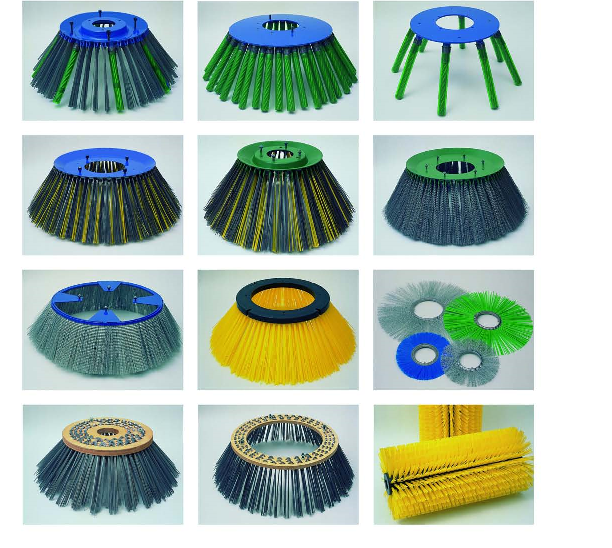
Gutter Weed Brushes in the size and for the machine you need it for.



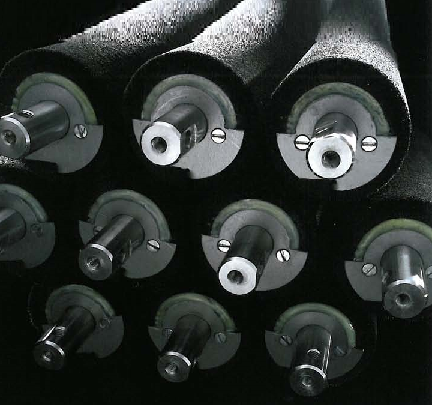
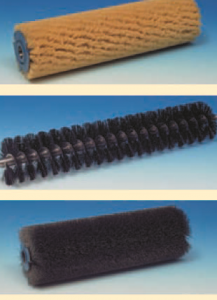
Brush rollers are made in two designs: the punched design and the spiral design. Depending upon the function required the density of the brush is determined as well as the gauge of the fibre and the length of the fibre. Optimal results can be obtained with both straight and crimped fibres. Brush rollers are specially designed for cleaning units in the offset rotation print, for rubber cloth, back-pressure cylinder, humidifying units and brushes for the cleaning and washing of offset plates. If necessary brush rollers can be recovered.
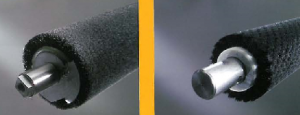
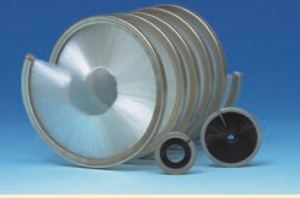
(with inward-facing bristles)
Produced in a metal channel with the bristles pointing inwards.
This design version has many applications.
Measurements can vary from 20 mm outer diameter upwards, depending on the channel size.
It can be designed as a single ring or a complete spiral.
Can be used as a seal.
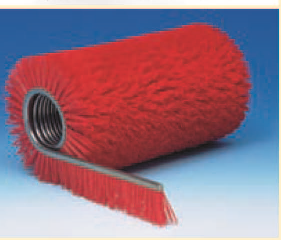
From a technical point of view the double band spiral brush is a well conceived tool. This type of spiral brush was developed from experience gained in the manufacture and use of the single band spiral brush.
It is important to use the double band spiral brush where it is technically appropriate, namely where heavy duty and hard bristle are used at high speeds.
The double band spiral brush channel consists of two metal strips, the outer strip holding the inner strip into place. The number and size of bristle tuft apertures can vary. This type of construction offers the advantage of providing different and accurately measured bristle tuft densities and it is appropriate for a wide range of bristle types, from very fine to heavy duty steel or synthetic fibres. The bristles remain firmly fixed at all times.
The advantage of double band spiral brushes, is that should the brush be damaged, bristles are lost only from the site of the damage, whilst the remaining bristle tufts are clamped separately.
Double band spiral brushes are made to the required length with an internal diameter of 20 mm upwards. They can be supplied in various channel widths and with every type of bristle material.
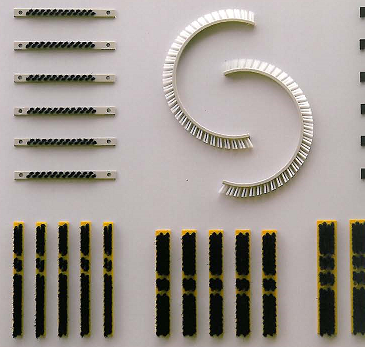
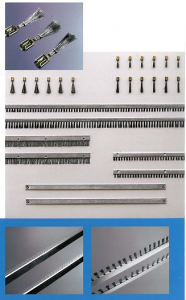
Brush laths are extremely useful for conveying, slowing down, pressing and printing of paper in folding machines. This product is also used for the guiding of boxes and the adhesion of labels. Special brush laths are made for the supporting and guiding of cartons, where special glass fibre filaments are used. Brush laths are mostly made with plastic backs. The filaments are of synthetic fibres, horsehair or Chines pig bristle. Depending on the application, the bristles can be angled to improve performance.
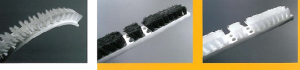
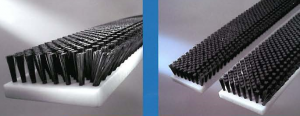
Brush plates with a synthetic stock are made in various sizes. Depending on their usage, the density, the gauge of the fibre and the fibre length can be varied. Always a high-quality fibre is used for these applications. Brush plates are being used for the cleaning of printing rollers in the flexoprint process as well as the guiding and supporting of products. For special applications, it is possible to round the tips of the fibres, in order to obtain even better results.
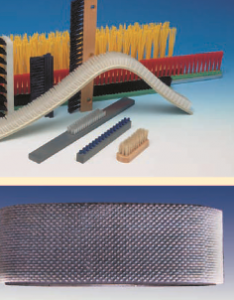
Brush lathes are an all-round product, which can be applied very efficiently in many different situations. This product can often improve your production processes. By using a very flexible combination of materials, a product is developed with multiple applications and appearances.
Brush lathes are applied for example in cleaning, roughening, spreading, transporting, closing, speed reducing and wiping of products. They are also especially suited in the moving and guiding of vulnerable products.
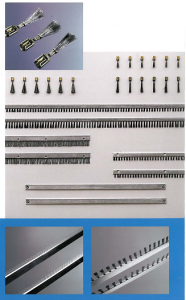
Especially in production processes of the paper-, foil- and carton industry static charge is a problem that has to be dealt with.
It disrupts the production and the surrounding electronic devices can be seriously influenced.
These brushes are available in several designs such as brush strips, brush laths, plug brushes and special designs.
They are made of conducting materials, most of the time with aluminium or a synthetic-conducting centre.
The most common fibres are carbon fibre, thunderon and stainless steel.